

 Early Pioneers
The Past
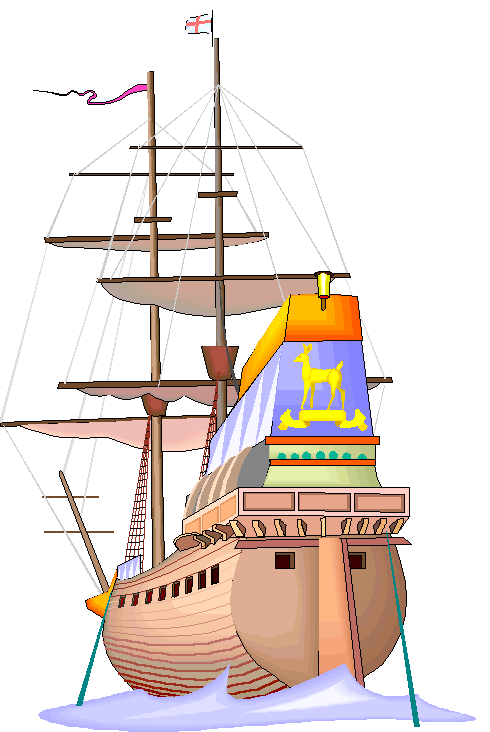
Most of the people on the ship were British
but there was a section checked of for the Poles.
Andrew
=s, Dorothea=s and Ignatius=s names were on the list.The history of the Lepack homestead begins with the great-grandparents, Andrew and Dorothea Lepack, immigrating to Canada in 1887 and settling in the Polish Hills about eight miles north of Otter Lake, Quebec.
During the 1850's and 1860's the lumber industry in Canada
was booming. Many immigrants from European countries were lured by this,
and the possibility of establishing a new home in Canada. Agents
were hired to find people willing to settle on recently-cleared crown land. Over 120
families came, beginning in the 1860's. One group of Polish people, the people who settled near the village of Otter Lake, were the Kashubs of Cassubia.
Cassubia is a wedge of land south and west of Gdansk and the AHook
of Hell@
which juts into the Baltic Sea.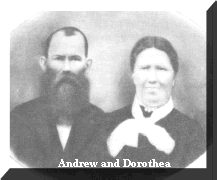
Many settled the nine-mile Opeongo Trail which started at Farrell=s Landing on the Ontario side of the Ottawa River opposite Portage du Fort, Quebec. Polish immigrants realized that the land was not suitable for farming and left the Opeongo Trail. They crossed the Ottawa River and moved to the closest available land, which they found near the Picanoc River north of Otter Lake, Quebec. The land was not much better, but the Kashubs painstakingly cleared and planted the land in what is now called the Polish Hills.
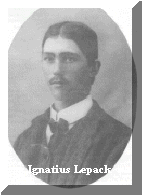 Andrew Lepak of Zalisia, (age 25), married Dorothea Zywicka,
(age 26), January 25, 1866 in Brushy, Poland. Their first-born son, Ignatius,
was born in Zalisia, Poland, on January 30, 1887. The original spelling of their
name was later changed from Lepak to Lepack. Andrew, Dorothea and Ignatius
sailed from Glasgow, April 21, 1887, when Ignatius was only 14 weeks old.
The ship, S. S. Norwegian, made a stop at Liverpool, England on April 22, and
then arrived in Quebec City and Montreal on May 5, 1887. There was a beginning
total of 686 passengers on arrival. The master=s
name was Robert Carruthers.
Andrew Lepak of Zalisia, (age 25), married Dorothea Zywicka,
(age 26), January 25, 1866 in Brushy, Poland. Their first-born son, Ignatius,
was born in Zalisia, Poland, on January 30, 1887. The original spelling of their
name was later changed from Lepak to Lepack. Andrew, Dorothea and Ignatius
sailed from Glasgow, April 21, 1887, when Ignatius was only 14 weeks old.
The ship, S. S. Norwegian, made a stop at Liverpool, England on April 22, and
then arrived in Quebec City and Montreal on May 5, 1887. There was a beginning
total of 686 passengers on arrival. The master=s
name was Robert Carruthers.
Most of the people on the ship were British, but there was a section set aside for the Poles with a check mark and inscription (Poussian Poles Gneudsui Reupen Coy Assished and Reupmstu Spcl 9.30 Pubmay). The inscription was written beside their names on a list. Andrew
=s, Dorothea=s and Ignatius=s names were among those on the list.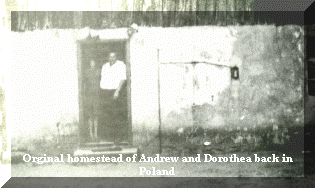
Andrew and Dorothea raised a family of eight children, and lived on the farm until their deaths. Their son, Joseph, and his wife Margaret then farmed the land until 1967 when they moved to Campbell
=s Bay, Quebec. Joseph=s son, Kenneth, later took over the farm. The farm was sold in 1992 to my husband and me, Jack and Deborah Gauthier. We are still the owners.ANDREW LEPACK
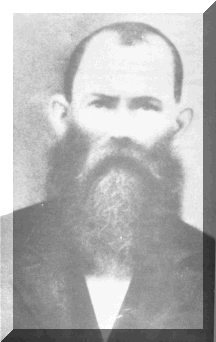 Andrew was a small short man with long whiskers. He was a
gentle man with a mild temperament and was full of wit. He enjoyed having a
drink or two with his friends and telling stories about his childhood in Poland.
He could tell stories for hours to entertain the grandchildren. Every Christmas
he would dress up a Santa Claus and deliver treats to the children in the area.
Andrew was a small short man with long whiskers. He was a
gentle man with a mild temperament and was full of wit. He enjoyed having a
drink or two with his friends and telling stories about his childhood in Poland.
He could tell stories for hours to entertain the grandchildren. Every Christmas
he would dress up a Santa Claus and deliver treats to the children in the area.
His reason for choosing the place on top of the mountain was because it was always warmer and closer to heaven. This was one of his jokes. According to those who knew him he was well liked in the community. He often would make long trips by horse and buggy to Renfrew or Ottawa to visit relatives. It would take him close to a week sometimes to get there because the boundaries of farms were not clearly marked.
He would also visit his relatives in the United States, who had settled in Milwaukee, Wisconsin. When Ignatius was sixteen, he left him to look after the farm while he visited those in the U.S.
=s on Bank Street as they had sheds at the back of the house where he would keep his horse while he would visit the rest of the relatives.Grandpa Andrew used to make a trip to Renfrew once a year to visit relatives and used to stay at Simon and Mary Zavitski
--Joseph Libera
Andrew was a fair and just man. He only wanted what was his and that was all. There was no fence between the two farms where he had bought land for his son Ignace. He had the surveyors survey the land to make sure there would be no dispute.
DOROTHEA LEPACK
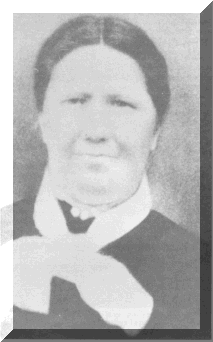 According to the memoirs written in the family history book,
her descendants speak of her as a small plump little lady who always carried a
pocket of white peppermints. She enjoyed her grandchildren when they came to
stay with her during holidays and on weekends. Sunday mornings they would return
to the village when everyone went for Sunday mass.
According to the memoirs written in the family history book,
her descendants speak of her as a small plump little lady who always carried a
pocket of white peppermints. She enjoyed her grandchildren when they came to
stay with her during holidays and on weekends. Sunday mornings they would return
to the village when everyone went for Sunday mass.
Maple syrup time was a particularly favorite time for Dorothea and the grandchildren. She looked after the boiling of the sap into syrup. She would stay the whole night at a little shack with the grandchildren, who would snuggle up with her because they were afraid of the dark and the woods outside.
It was so cold during the winter. She would make the children wear a black
ABubushka@, which is a Polish word for kerchief. They hated it and would take it off as soon as she was out of sight.Many friends and relatives used to come to the homestead to spend some of their summer holidays or to go on a fishing trip. She was a great cook because they returned year after year. She was also a good one to play tricks on people. During the hunting and fishing seasons, men would come to stay. They loved to play tricks on the children. Dorothea would help to get even. While the men were out she got the children to sew their shirts sleeves and pant legs together.
There was a lot of work on the farm. Besides going to school, the children had plenty of chores to do. Planting in the garden, harvesting, raking hay, rounding cattle, picking berries, and helping with canning and preserving were just a few to mention.
JOSEPH LEPACK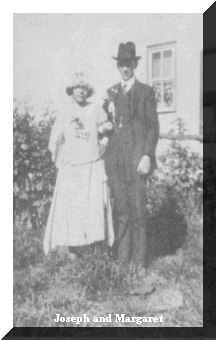
Joseph was the second son of Andrew and Dorothea. He grew up helping his parents on the farm and working in the bush in the winter.
He married Margaret Yereck on October 1, 1923. They settled on the homestead and had a family of seven children: Francis, Alexander, Adam, Frank, Monica, August and Kenneth. Adam died in infancy. Dorothea lived with them until she passed away in 1928. Francis, Alex, Frank , Mona and Ken, as we became to know them, were the last descendants to live in the house. Ken, the youngest inherited the homestead. He did not live there, instead he sold the farm and later we became the owners.
Many tourists from Ottawa and the United States would spend their summers, weekends and holidays at the farm. They would come for hunting and fishing trips. Joseph would transport the men to the lakes in back of the farm, while their wives and children would stay at the house. Some of those tourists have returned to visit the homestead and have told us stories of their adventures. Some of them were only children when they stayed there. They said they were treated very well, and that Margaret was an excellent cook.
Some told us they were treated special. They would eat in the
dining room, while the Lepack children would eat in the summer kitchen. All the
children would play together, so they would curiously peak through the window of
the summer kitchen to see what the Lepack children were doing.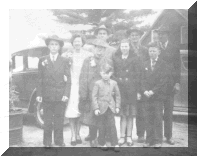
We became very good friends with Francis, Alex, Frank, Mona and Ken the last remaining from Joseph
=s family. They treated us like we were member of their family and enjoyed frequent visits to the farm. They told us many memoirs of their growing up at the homestead.Picture on right: Back, left to right:: Ales, Joseph Frank. Centre, left to right:: August, Mona, Margaret, Francis and husband Victor Leach. Front: Kenneth
 Return
to Hunting-Fishing Lodge
Return
to Hunting-Fishing Lodge
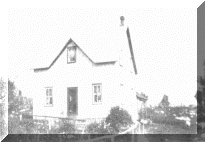
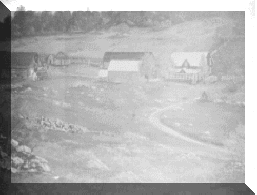
Joseph came by difficult times during his life. Their fist home burned in 1937 and the family was forced to live in the barn and sugar cabin. They had to rebuild another house. Which is the house that exists today. In 1949 he had a serious accident. After being gored by a bull he spent much time in the hospital recuperating.
Picture The first house build by Andrew which burned in 1937
 Joseph built a new house for his family to live in, and this is the house still
exists today. Those who remain of his family told
us about the time when their house burned.
Joseph built a new house for his family to live in, and this is the house still
exists today. Those who remain of his family told
us about the time when their house burned.
They had to live in the sugar cabin in the winter so they could have heat. People from the community brought dishes, pots, blankets and various items they needed. Some of the old dishes and pots still remain upstairs in the barn today. I am told that they lived upstairs in the barn during the summer months. Above: House built by Joseph
PIONEER LIFE IN THE HILLS

The pioneers built shacks with scooped roofs in the middle the virgin forest. They cleared the land of heavy timbers. The lakes and Picanoc River provided them with fish. They hunted deer, moose, grouse and rabbits in the nearby forest and bought horses, cows, sheep, pigs and hens.
Women made coats, pants and shoes out of deer hides. After soaking the hides for a few days the hair was loose enough to be scraped of, and then the hide was stretched and pulled until it was soft to work. Wool from sheep was spun to make warm clothes for the winter.
Early settlers made sauerkraut from cabbage. They chopped cabbage and layered it with salt in large wooden barrels. The cabbage fermented in a warm place for about three weeks. It stank up the whole house. When finished, it was stored in a cold place to be used throughout the winter. Sun-dried berries were stored all winter as well.
Milk and cream was separated. The cream was made into butter and poured into molds. The cover of the molds had a floral pattern which left its imprint on the butter. The beautifully carved molds were stored in stone crocks. Eggs were also stored in stone crocks. Potatoes, carrots and other root vegetables were stored in a root cellar.
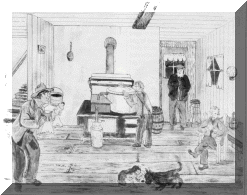 Potheen (pronounced pootsin) is the Irish name for moonshine.
The whiskey was distilled using beans, sugar, yeast and molasses.
During the Depression it was illegal to buy, sell, or make alcoholic beverages.
Therefore, many stills were hidden or thrown into lakes in order not to be found
by the RCMP.
Potheen (pronounced pootsin) is the Irish name for moonshine.
The whiskey was distilled using beans, sugar, yeast and molasses.
During the Depression it was illegal to buy, sell, or make alcoholic beverages.
Therefore, many stills were hidden or thrown into lakes in order not to be found
by the RCMP.
Left: Sampling of the Potheen
The early pioneers did not have very much money but they always had enough to eat. With the wild animals and the berries in the bush, the fish in the river and a carefully tended garden, the early pioneers were able to raise healthy and very large families.
--Rosie Kluke
An end has come to the community that once flourished near the Picanoc River. The farms have been vacated, but the Polish Hills will always remain home to many descendants of the early homesteaders, who are proud of their forefathers. We are now the only permanent residents living at the top of the Polish Hills. Most of the vacated farms are now used as hunt camps or as summer homes.
William Kurelek is a Canadian painter whose works depict mostly prairie landscapes and Canadian history. This painting, Christmas at Otter Lake, was painted by him to give some recognition to the Poles living in Quebec.
CHRISTMAS AT OTTER LAKE
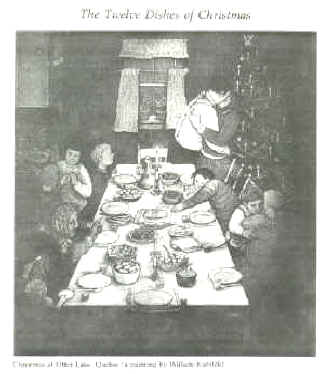
=s invitation, has inspired them to revive some Old Country culture. That=s her wagging her finger at her grandson impatient to get eating and reaching for an extra oplatek.I set the time of this picture back in the 1920's hoping thereby to assume Polish Christmas customs of the Old Country would be in fact substantially preserved, since Ukrainian Christmas customs were mostly intact in our own home in the West back in the 30's. But the Kaszuby Poles to who I showed the painting just after it was finished hardly recognized anything in it. I therefore had to assume that the granny in the picture, fresh from Poland on her children
Roughly the order of dishes as the family would eat them is: barszcz (beet soup); uszka (dumplings with mushrooms); jellied fish; golabki (cabbage rolls stuffed with rice or buckwheat); fried carp; pierogi (dumplings stuffed with cabbage, cheese or potatoes); fruit compote; varied baked sweets (apple strudel, poopy-seed rolls).
You may notice two empty chairs. They are ceremonially put there to welcome unexpected guests. Unlike Ukrainians, Poles always have a Christmas tree even if they are so poor that they have to use coloured paper to make decorations.
--William Kurelek
Christmas at Otter Lake is an oil painting with dimensions of 20" x 20", and is currently displayed at the Art Gallery of Hamilton, Ontario.
I often like to believe that this is a painting of my kitchen at the Lepack homestead.