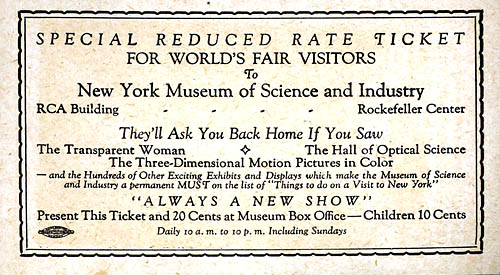
New York Museum of Science and Industry RCA Building, Rockefeller Center New York, NY, USA 1936
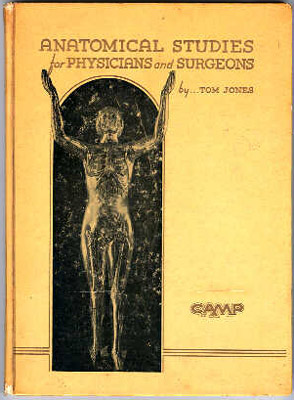
Book published by the S.H. Camp and Company in 1936. The
book features a full color picture of the "Camp Transparent Woman."
This was the first female model made by the Dresden Hygiene Museum.
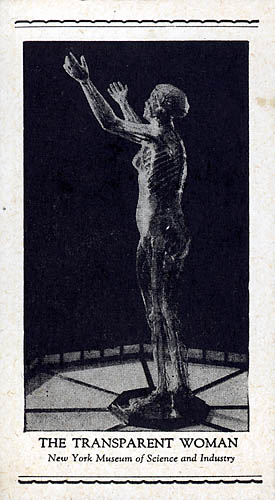
The model was displayed at the New York Museum of Science and Industry.
1937
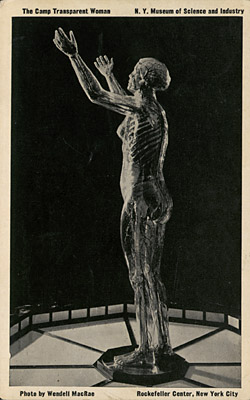
Postcard postmarked Jan 1, 1937.
World'd First Showing
THE CAMP TRANSPARENT WOMAN A scientific representation of the female body in three dimensional
perspective, reproducing the internal organs of a typical woman, approximately
30 years of age. One of hundreds of interesting exhibits on view
in the Hall of Motion.
(Manhattan Post Card Publishing
Co., Inc.)
1939-1940
Article from TIME Magazine on the Camp Transparent Woman
Manhattan copyreaders made bad jokes about womanhood last week
when a lifesize, transparent figure of a woman, which had arrived from Germany,
was placed on exhibition at the Museum of Science & Industry. Within this
strange image, standing with outstretched arms, were visible a skeleton, most of
the female internal organs, a complete set of blood vessels. The arteries were
stained red. the veins blue. Since this was the only figure of its kind in the
world and this was its first public appearance anywhere, appropriate ceremonies
were held and an informal physiology lesson was radiocast. Present were Dr. Dean
Dewitt Lewis, surgeon-in-chief of Johns Hopkins Hospital, Explorer Roy Chapman
Andrews (dinosaur eggs) and Samuel Higby Camp, surgical bandage manufacturer of
Jackson, Mich.
Highly skilled craftsmen of the German Hygiene Museum in Dresden
have constructed four transparent men, one of which was shown at Chicago's
Century of Progress.— Desiring to sponsor the. first transparent woman,
principally as an educational exhibit for the U. S. public and incidentally as
an advertisement for his bandages, Mr. Camp, after being quoted a price reputed
to be $20.000, told the Dresden artisans to go ahead. First, the skeleton of a
young Dresden woman, killed in an accident, was treated with preservative,
covered with paraffin. Brain, heart, stomach, lungs, thyroid, liver, spleen,
pancreas, bladder and other organs were taken from corpses, made transparent by
a secret process, dyed, photographed in color, enlarged, projected on a screen
in three dimensions. From these projections artists made tracings which were
used by sculptors to model the organs which actually went into the figure. The
viscera as well as the glassy frame of the transparent woman are made of a
material called cellhorn, which is tough, resilient, impervious to temperature
and humidity.
The Camp Transparent Woman is not a robot in the sense of having
movable parts, nor does any fluid circulate in her veins and arteries. Her
virtue as an educational instrument is that each organ may be separately
illuminated for the study of minute details. For this purpose the figure is
equipped with 20 pairs of lamps. Since these are of only four volts each, the
exhibit has its own motor-generator. No more than a few organs are lighted at
one time, to avoid overheating.
After two months in Manhattan, the transparent woman will go to
the Clinical Congress of the American College of Surgeons in Philadelphia, then
to 100 U. S. cities where the public may see her free of charge. Eventually Mr.
Camp will present her to a medical college or museum.
—This is now at the Mayo Clinic in Rochester, Minn. The three
others are in Buffalo, Stockhol